Autonomous mowing systems for 2.5 to 10 acre properties
The 2.5–10 acre window is the sweet spot for autonomous mowing — too big for a consumer wire-bounded mower, too small for a commercial multi-unit deployment. This page walks through what an AutoAcre system looks like tier by tier: what install involves, what the Buy + Manage fee works out to, and what 8 years of ownership saves vs a fortnightly contractor at your specific acreage.
Why 2.5–10 acres specifically
The acreage band where autonomous mowing makes the cleanest economic and operational sense isn't arbitrary. The lower bound, upper bound, and shape of the offer are all driven by what the technology actually does well at scale. Standard robot mowers fail at acreage because boundary-wire systems can't be physically installed across multi-acre runs without permanent failure points, and consumer-grade GPS drifts metres rather than centimetres — neither approach scales beyond a quarter-acre suburban yard. RTK navigation is what makes acreage automation viable.
Below 2.5 acres
A consumer wire-bounded or consumer-GPS robot mower is the better economic fit. AutoAcre's commercial-grade hardware is overspecified at sub-3-acre scale — you'd be paying for slope handling, daily-throughput capacity, and RTK precision your property doesn't need. Honest answer: don't buy our system at 2 acres unless you specifically need the slope or terrain capabilities.
2.5–10 acres
The single-unit sweet spot. The mower's about 8 acres a day capacity comfortably covers a 10-acre property with margin; 30° slope handling clears most Northern Rivers hinterland; RTK precision is the dividing line between consumer mowers that drift and a system that holds boundaries cleanly across multi-acre terrain. Buy + Manage pricing works cleanly here — the system amortises across enough acreage to justify the up-front capital, and the management fee scales smoothly.
Above 10 acres
The conversation moves to commercial scope. A single autonomous mower will still cover 11–20 acres, but the day-to-day operational profile changes — multi-zone scheduling, multi-unit deployment for properties beyond 20 acres, separate quoting per site. AutoAcre handles those as commercial deployments under a different agreement structure rather than the standard residential Buy + Manage offer.
What the system looks like at your acreage
Four representative tiers — 2.5, 5, 7 and 10 acres. Each describes the property type AutoAcre most often sees at that scale, what install involves, and what 8 years of ownership economics work out to.
2.5 acres — the lifestyle starter Fee quoted after a site assessment
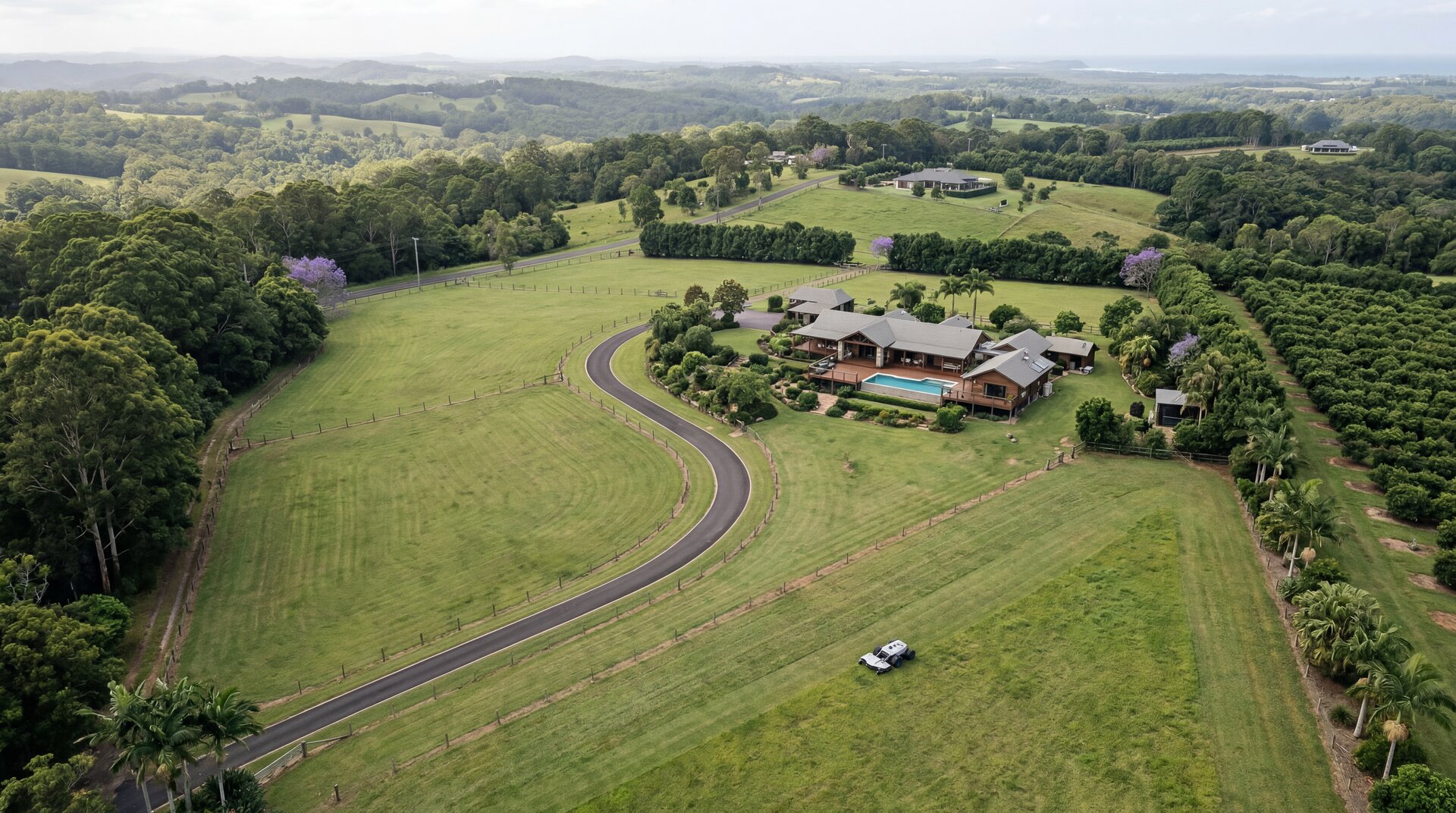
Typical property: a smaller hinterland block, often 1.5–2.5 acres of mowable lawn around a homestead with the balance in bushland, dam, or garden. Common profile: holiday rental in Newrybar or Federal, absentee owner's weekender in Bangalow, retired-couple lifestyle block in Ewingsdale.
Mowing reality: a single mowing zone plus a few exclusion zones for garden beds and the dam. Each autonomous run takes around an hour, and the system runs about 78 times a year (twice-weekly summer, weekly winter). The mower spends most of its time docked — duty cycle is well below daily-use thresholds, which is why service life lands at 8+ years.
Install: straightforward. Single RTK base station mounted on the existing shed or carport, single charging dock under shelter, half-day boundary mapping. Typically a one-day commission.
8-year economics: over 8 years this tier comes out ahead of a fortnightly contractor, and you own the asset at the end of it (we estimate 20% residual). It's the narrowest gap on the residential range. The economics depend on what you spend on mowing now and how much of your block is actually mowable. We work both out at the site assessment.
Best fit at this tier: holiday-rental and absentee-owner properties where consistent weekly presentation matters more than the absolute cash gap. The 2.5-acre tier is where the AutoAcre system makes the most operational sense even if it's not the largest cash savings on the residential range.
5 acres — the classic Northern Rivers lifestyle block Fee quoted after a site assessment
Typical property: the canonical hinterland block — a homestead with paddock, lawn around the house, mature trees, and often a small orchard or chook run. Common profile: established family acreage in Bangalow, Newrybar, Mullumbimby; smaller equestrian properties; semi-retired hinterland buyers from Sydney.
Mowing reality: 2–3 mowing zones — the lawn near the house, a paddock area, sometimes a separate zone around an outbuilding. Slope variation matters here; most 5-acre blocks have at least one section the autonomous mower handles that a contractor's ride-on shouldn't. Cadence stays the same as 2.5 acres — twice-weekly summer, weekly winter — but each session covers more ground.
Install: standard. Half a day of boundary mapping, careful exclusion-zone configuration, base station typically mounted on a shed or pole near the charging dock for clean line-of-sight to most of the property.
8-year economics: the 5-acre tier is where the gap against a fortnightly contractor starts to compound, and you get the asset and 3× the mowing cadence on top. The numbers depend on what you spend on mowing now and how much of your block is actually mowable. We work both out at the site assessment.
Best fit at this tier: established hinterland owners frustrated with fortnightly contractor cycles. 5 acres is where most "I'm tired of having a paddock between mows" conversations land.
7 acres — the larger estate Fee quoted after a site assessment
Typical property: a substantial hinterland estate — homestead, multiple paddocks, often horse facilities, occasionally a separate guest dwelling or barn. Common profile: established equestrian properties in Federal/Clunes, prestige Byron-area lifestyle blocks, semi-rural multi-generation holdings.
Mowing reality: multi-zone scheduling with longer paddock runs, careful exclusion zones for orchard rows, garden beds, and animal areas. The system handles bushland edges as exclusion boundaries — RTK precision means the mower stops cleanly at a treeline rather than drifting into rough ground. Mowing cadence is unchanged but the per-session run is meaningfully longer.
Install: more involved. Boundary mapping takes most of a day, multiple exclusion zones for horses or livestock, careful base station placement to maintain RTK signal across distant zones. Properties with bushland between paddocks sometimes need a relay configuration.
8-year economics: the 7-acre tier is where the 8-year contractor bill gets uncomfortable enough that a lot of owners start doing the sums. What you spend on mowing now and how much of the block is actually mowable decide the rest. We work both out at the site assessment.
Best fit at this tier: equestrian and large-residential acreage where contractor visits routinely run $1,200–$1,500/month and the property still spends half each fortnight looking under-presented.
10 acres — top of residential range Fee quoted after a site assessment
Typical property: top-of-range hinterland estate or rural-residential holding. Common profile: prestige acreage in Newrybar/Bangalow valleys, larger equestrian operations, semi-commercial small holdings still operated as residential.
Mowing reality: the upper limit of single-unit comfortable capacity. about 8 acres a day rated throughput means a 10-acre block finishes in roughly 8 hours per cycle — well within a single day, but the day is fully utilised. Multiple zones, longer paddock runs, careful sequencing of which zone gets cut on which day. Some 10-acre owners eventually add a second unit (sharing the same RTK base station) when mowable area expands.
Install: the most complex residential install. Boundary mapping is a full day, careful base station placement matters because line-of-sight to all zones drives RTK reliability, and paddock-to-paddock transit routes need to be configured. Often involves a small shelter build for the charging dock if no suitable existing structure is positioned correctly.
8-year economics: the largest saving on the residential range. At this scale a fortnightly contractor is a serious annual line item, year after year. We put your actual numbers together at the site assessment.
Best fit at this tier: top-of-range estate owners who care about consistency at scale, not just savings. The 10-acre tier sits right at the boundary of residential and commercial — properties beyond this point are quoted individually under a commercial agreement.
How the tiers compare
The pattern across the tiers is the same. The monthly management fee scales with mowable acreage, and the gap against a fortnightly contractor widens as the block gets bigger. On top of the cash you get 3× the mowing frequency and the asset is yours at year 8, with an estimated 20% residual. A few ad-hoc call-outs a year sit on the AutoAcre side of the ledger.
We quote the fee after a site assessment, because it depends on what you spend on mowing now and how much of your block is actually mowable. Start with the ROI calculator →
Bigger property, same system
Stays constant from 2.5 to 10 acres
- The hardware: same RTK base station, same commercial-grade autonomous mower, same LiDAR sensor stack
- The launch reference price covers the entire 2.5–10 acre range
- Mowing cadence: twice-weekly summer, weekly winter (~78 mow days/year)
- What the management fee covers (maintenance, monitoring, repair coordination, advisory)
Scales with acreage
- Monthly management fee (scales with mowable acreage)
- Per-session run time (longer for bigger blocks)
- Install complexity (more zones, more careful base station placement)
- Cash savings vs contractor (compounds significantly with size)
For the whole-system view including ownership economics, ongoing operation, and what's covered: read the Acreage Solutions hub →
For the RTK navigation technology depth, read RTK Robot Mower Installation. Specific suburb fit at Byron Bay, Bangalow, and across the wider Northern Rivers service area.