What an autonomous mowing system on your acreage actually is
RTK and LiDAR robotic mowing engineered for 2.5–10 acre Northern Rivers properties — sold and serviced under AutoAcre's Buy + Manage offer. You buy the system outright. AutoAcre operates it ongoing. Below, the whole offer end to end.
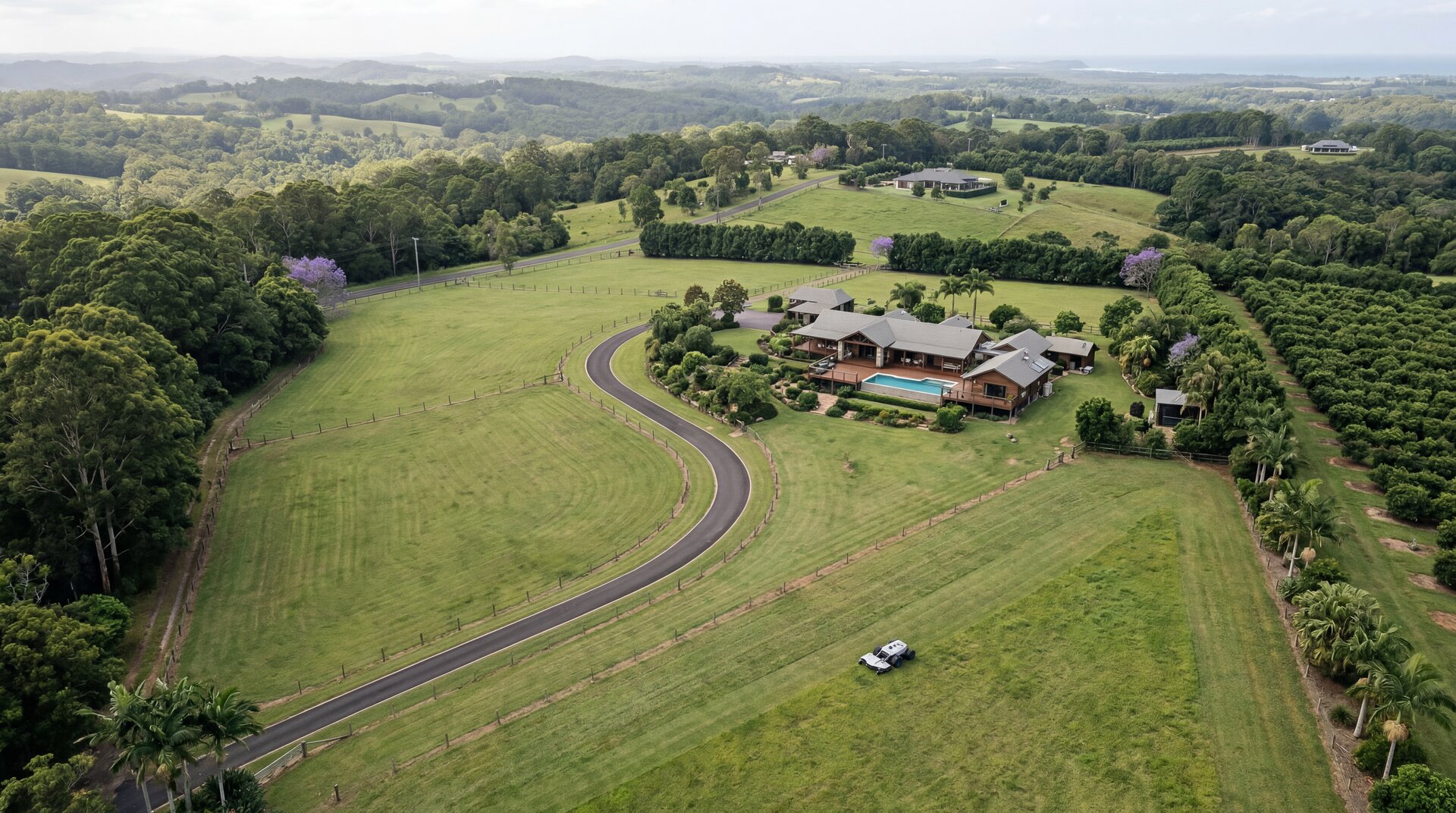
Four parts. One offer.
An "autonomous mowing system" isn't just a robot — it's the four components that together let unattended mowing actually work at acreage scale. AutoAcre supplies and configures all four under a single Buy + Manage offer.
RTK base station
A fixed satellite reference unit installed on your property — usually on a shed or pole near the charging dock. Provides centimetre-accurate positioning corrections to the mower in real time. One base station serves the whole property; one base station can also support multiple mowers if your acreage scales beyond a single unit.
Commercial-grade autonomous mower
The mower itself — 48-inch deck, about 8 acres a day capacity, 30° slope handling, 8-hour battery, electric drive (≈60dB operating noise). Maps your property once during installation, then mows the same paths every cycle. No buried boundary wire to cut, drift, or replace over time.
LiDAR sensor stack
Laser-based real-time obstacle avoidance built into the mower. Detects fallen branches, garden hoses, sleeping dogs, kids' bikes left in the grass — and stops or routes around them dynamically. RTK without LiDAR is precision-blind to anything new on the property; LiDAR is what makes it safe to leave the mower running unattended.
Ongoing managed service
The fourth component is the part nobody else in the Northern Rivers offers: AutoAcre operates the system on your behalf. Remote monitoring, scheduled maintenance, blade replacements, firmware updates, repair coordination, advisory. The system is yours. The day-to-day operation is ours.
Want the technical detail on the RTK base station and install process? Read RTK Robot Mower Installation.
Why RTK and LiDAR specifically
Most "robot mowers" sold in Australia use one of two older approaches. Boundary-wire robot mowers use a buried perimeter cable — a physical perimeter cable that defines the mowing area. Cheaper consumer GPS mowers use single-receiver positioning with metre-level accuracy. Both have specific limitations on acreage.
Boundary wire is fine on a quarter-acre suburban lawn, but on a 5-acre block it's a multi-kilometre cable run that takes hours to install, costs hundreds of dollars in wire, and fails permanently the first time a tree root, gardener's spade, or paddock erosion cuts it. Single-receiver GPS drifts metres in either direction depending on satellite geometry — not viable for following the same paths or staying out of garden beds.
RTK fixes the GPS problem. A fixed reference station on your property broadcasts correction data to the mower; positions resolve to within 2 cm. The mower follows the same routes every cycle, holds boundaries to a few centimetres, and handles slopes that would defeat a wire-bounded unit.
LiDAR fixes the obstacle problem. RTK alone is precision-blind to anything new in the environment — fallen branches, unexpected pets, kids' bikes left out. LiDAR scans the immediate surroundings continuously and stops or routes around them in real time. RTK and LiDAR together is the dividing line between equipment that works on a manicured suburban lawn and equipment that works on a real working acreage.
How Buy + Manage works in depth
AutoAcre publishes one residential offer: Buy + Manage. The customer buys the autonomous mowing system outright. AutoAcre handles every operational thing that follows.
There are simpler offer shapes — pure subscription where AutoAcre owns and rents the mower, or pure sale where you buy and then operate it yourself. We tried both at the start and neither held up: subscription concentrates all the hardware risk on AutoAcre, and pure sale leaves the customer running firmware, RTK base configuration, blade replacement schedules, and remote diagnostics most acreage owners would rather not run. Buy + Manage is the middle path. The asset risk is yours (which it should be — it's your equipment); the operational complexity is ours (which it should be — that's what we know how to do).
BUY — the system, yours to keep
The system is sold outright. That includes the RTK base station, the commercial-grade autonomous mower with LiDAR, professional installation, and boundary mapping for your property. Final price varies by manufacturer match — AutoAcre selects the unit best suited to your terrain rather than anchoring to a single platform.
The system becomes yours. You own the asset. You can sell it. You can take it with you if you move. There's no lock-in on the BUY side — once installed, the hardware is straightforwardly yours.
Quick caveat: the secondary market for commercial-grade autonomous mowers in Australia is thin. Residual value at year 8 is estimated at ~20% (around 20% of the system up-front cost) but it's an estimate, not a quote.
MANAGE — operations under one fee
One tiered monthly management fee. It scales with mowable acreage, from 2.5 acres up to 10. We quote it after a site assessment, once we know how much of your block the mower will actually run on.
The fee covers scheduled maintenance, blade replacements, firmware updates, remote monitoring, and repair coordination. Mowing cadence is twice-weekly in summer and weekly in winter — about 3× a fortnightly contractor.
Month-to-month, 30 days notice, no lock-in. The system is yours regardless; cancelling management just means you're operating it yourself going forward.
How the system operates
Once installed and commissioned, the system runs itself. The day-to-day reality of living with autonomous mowing on acreage is calmer than most expect — and noticeably different from the fortnightly contractor cycle.
Cadence: ~78 mow days/year
Twice-weekly in summer (≈26 weeks × 2 = 52 mows). Weekly in winter (≈26 weeks × 1 = 26 mows). Total ~78 mow days/year — roughly 3× a fortnightly contractor at ~26 mows/year. Each individual mow is shorter and shallower than a contractor visit, which is exactly why it works at this frequency.
Quiet, electric, mostly invisible
Operating noise around 60dB — about the level of normal conversation. Fully electric drive, no fuel storage on site, no fumes. You'll see the mower if you're looking for it; you'll forget it's there if you're not. Most owners schedule overnight or early morning runs and never notice the system at work.
Safe around people, pets and obstacles
LiDAR scans the immediate environment continuously. Collision detection and lift sensors stop the mower immediately on contact. Operates at low forward speed (well below ride-on speeds). Exclusion zones for play areas, garden beds, pool surrounds and driveways are configured during installation and enforced by RTK boundary mapping.
What the management fee covers, and what sits outside it
The fee is structured around standard ongoing operation. Optional and ad-hoc work sits outside the fee so you only pay for what you use.
Covered by the standard management fee
- ~78 mow days/year (twice-weekly summer, weekly winter)
- Scheduled maintenance and blade replacements
- Firmware and software updates
- Remote monitoring and operational diagnostics
- Repair coordination if the unit develops a fault
- Advisory — ongoing operational guidance for the property owner
Sits outside the standard fee
- Ad-hoc on-site call-outs, charged per visit (e.g. manual mow during downtime, special requests)
- Edge trimming along hardscaping — separate contractor recommended for periodic edge work
- Weekly photo reports — available on the higher management tier (quote-only)
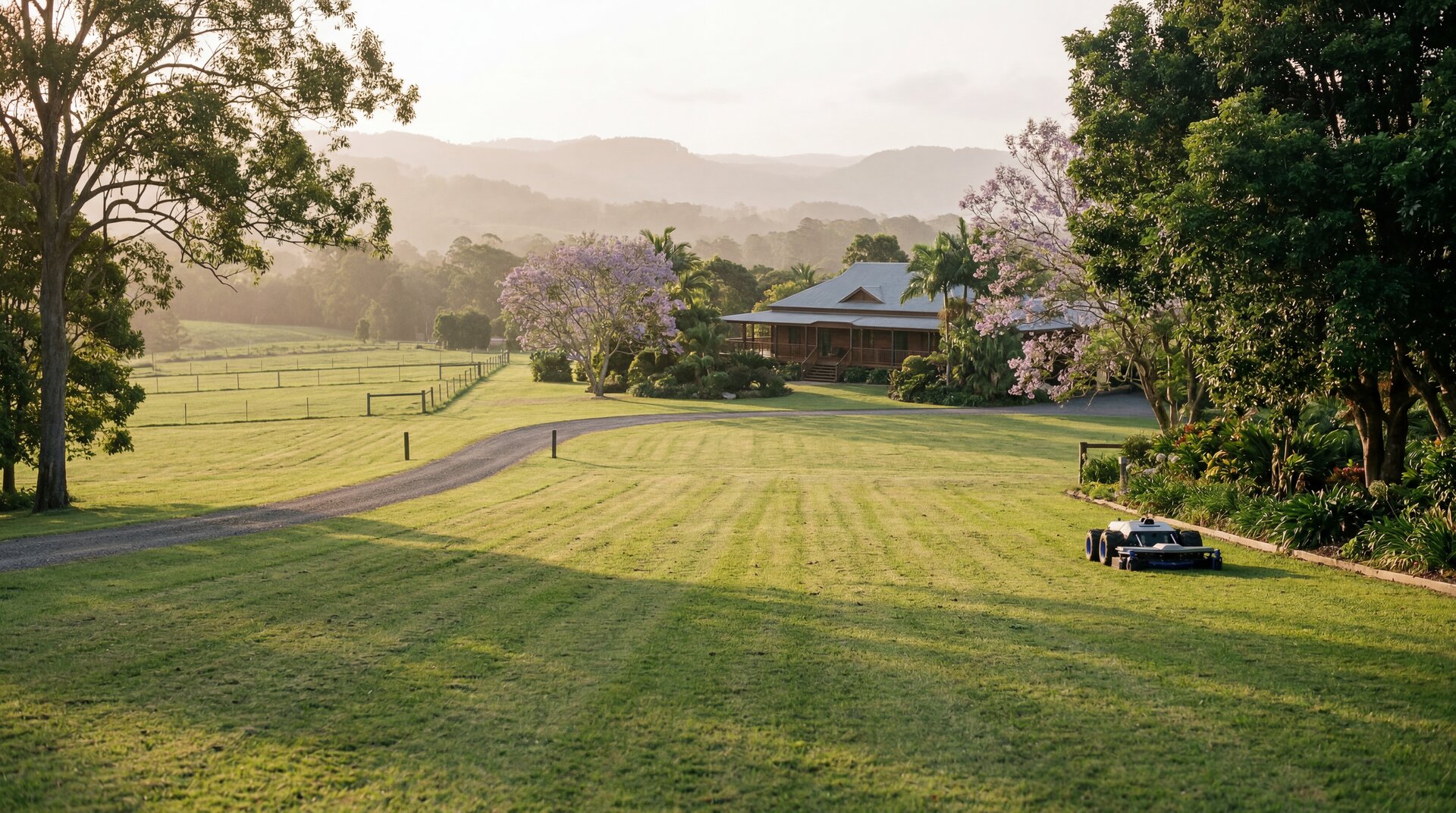
What this looks like over 8 years
The economics work out cleanly over an 8-year window because the up-front asset cost amortises across a longer period and the ~78-mow-day duty cycle keeps wear low enough to justify it.
The Northern Rivers premium acreage benchmark for a fortnightly contractor is around $250/acre/month. That's a bill that keeps arriving for 8 years, and at the end of it you own nothing.
On the AutoAcre side, the up-front system cost is one-off and the management fee scales with mowable acreage. The gap in your favour widens as the block gets bigger. Net of the estimated 20% residual at year 8 and a few ad-hoc call-outs a year, it widens a bit further again.
What the gap actually comes to depends on what you spend on mowing now and how much of your block is really mowable. We work both out at the site assessment. Start with the ROI calculator →
Plus: ~3× the mowing frequency. Plus: you own the asset at year 8.
Is your property right for an autonomous mowing system?
The Buy + Manage offer is shaped specifically for 2.5–10 acre acreage. Below 2.5 acres, a consumer wire-bounded mower is usually the right fit. Above 10 acres, the conversation moves into commercial scope — multi-unit deployments, scoped per site.
Acreage size
2.5–10 acres of mowable area. Tier-by-tier fit and economics for each acreage size — read the full property-size deep dive.
Terrain
Slopes up to 30°. Most Northern Rivers hinterland properties — including undulating terrain — sit well within range. Extreme rocky outcrop or unmanageable rock-bed sections are evaluated case-by-case during site assessment.
Infrastructure
The charging dock needs a sheltered location with mains power. Reasonable cellular coverage is required for remote monitoring. Both are assessed during the on-site visit; a small shelter build is part of the install if no suitable location exists.
When an AutoAcre system isn't the right fit
Below 2.5 acres, the system is overspecified — a consumer-grade robot mower is the better economic match. Properties with extensive water features, dense rocky outcrop, or terrain that requires regular tree-canopy clearance are evaluated case-by-case. If your block has slope sections beyond 30° or persistent wet-soil zones, autonomous mowing isn't the right tool — a human operator with a tracked mower handles those better. We say this honestly during site assessment because misfit installations don't make good customers or good case studies.