Robot mower installation in Tyagarah
RTK + LiDAR autonomous mowing systems for Tyagarah acreage. The Buy + Manage offer for 2.5–10 acre coastal-plain lifestyle properties north of Byron Bay.
- Postcode
- 2481
- Council
- Byron Shire
- From Byron Bay
- 10 km N
- Typical mowable area
- 3–10 acres
- Dominant terrain
- Coastal hinterland flats
What acreage in Tyagarah is actually like
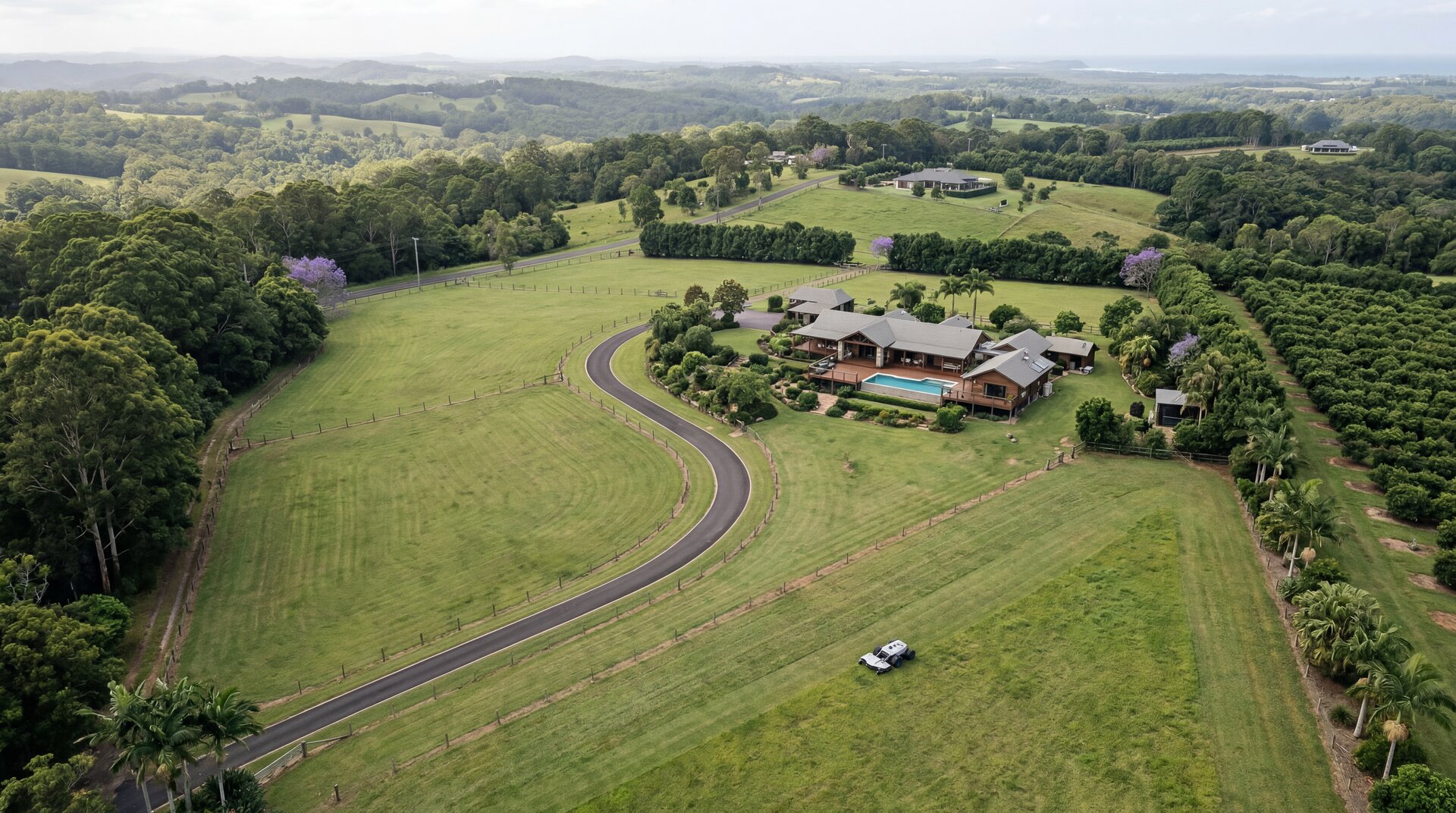
Tyagarah sits on the coastal plain just north of Byron Bay — flatter, sandier, and quieter than the village itself. The mix of acreage runs from established lifestyle blocks to substantial rural-residential holdings, with a meaningful share of properties carrying horse facilities or working pasture.
Terrain in Tyagarah is mostly flat to gently undulating — the area is part of the Byron coastal plain rather than the hinterland. Soil mixes sand near the coast with sandy-loam and clay-loam further inland; drainage is generally fast, particularly on the sandier blocks. Slopes are rarely a concern across the suburb.
Block sizes in Tyagarah run 4–10 acres for the standard residential profile, with some larger holdings on the inland side. Property profiles lean toward established residential acreage and a noticeable equestrian share — paddocks, horse facilities, and rotation patterns are common configurations. Holiday rental presence is meaningful but lower than central Byron Bay; most Tyagarah acreage is owner-occupier with a long-term horizon.
The local reality worth flagging: coastal influence. Salt-air corrosion is a real consideration for any equipment kept long-term in the area. The autonomous mower itself is rated for the conditions; the RTK base station is solid-state and weather-sealed for outdoor mounting; the charging dock placement under shelter (standard for any install) keeps the unit out of the worst of the salt-air weather. None of this is unusual for Tyagarah; it just shapes the install's small details.
RTK + LiDAR autonomous mowing for Tyagarah terrain
Flat-to-gentle Tyagarah terrain is straightforward for autonomous operation. The sandy and sandy-loam soils handle autonomous footprint well — the lighter pressure is irrelevant on free-draining ground that doesn't rut. RTK precision matters here for boundary holding more than for slope work.
The system itself is the same across the Northern Rivers — RTK base station mounted at a fixed reference point, commercial-grade autonomous mower with built-in LiDAR obstacle avoidance, charging dock placed under shelter, and the ongoing AutoAcre managed service. What changes from suburb to suburb is how the system is configured for the local terrain, not what gets installed.
For the technical detail on RTK and LiDAR specifically, see RTK Robot Mower Installation. For property-size deep dive at 3, 5, 7 and 10 acres, see 2.5–10 Acre Autonomous Systems. For the whole-system view including ongoing operation and ownership economics, see Acreage Robot Mowing Systems.
What it costs and what's covered
The Buy + Manage offer is the same across the residential 2.5–10 acre window — same hardware, same management coverage, same Q1 2027 launch. What varies on a per-property basis is the management fee tier, set by mowable acreage.
| Tyagarah property size | Monthly management fee |
|---|---|
| 2.5 acres | $165/month |
| 3 acres | $195/month |
| 5 acres | $330/month |
| 7 acres | $455/month |
| 10 acres | $650/month |
The tiered monthly management fee covers scheduled maintenance, blade replacements, firmware updates, remote monitoring and repair coordination. Mowing cadence is twice-weekly in summer, weekly in winter — about 3× a fortnightly contractor.
Run the ROI calculator with your specific Tyagarah acreage and current contractor cost →
What ownership looks like over 8 years
The economic case for autonomous mowing on Tyagarah acreage shows up over a longer window than most service comparisons consider. Year 1 is the heavy spend — system purchase plus 12 months of management fee. Years 2 through 8 are management fee only. By year 8 the cumulative cost has fallen well below the equivalent fortnightly contractor spend, and you own the asset.
On a 5-acre Tyagarah block, total 8-year cost runs approximately $65,170 (96 × $330 management + system up-front). The Northern Rivers premium contractor benchmark of $250/acre/month works out to roughly $120,000 across the same window. Net of estimated 20% residual value at year 8 (around $6,700) and 4 ad-hoc call-outs per year, AutoAcre lands roughly $57,000 cheaper over the period — plus the system's yours, plus you're getting about 3× the mowing frequency throughout. The numbers scale up at 7 and 10 acres, with the cash gap widening to ~$93,000 and ~$146,000 respectively.
The numbers are honest, with caveats published — residual value is an estimate (no established secondary market for commercial-grade autonomous mowers in Australia), call-out frequency is a guess (the offer is built around minimal ad-hoc work but it varies), and CPI on contractor pricing isn't modelled. The ROI calculator lets you plug in your specific Tyagarah acreage and current contractor cost for a tighter picture.
What an install looks like on a Tyagarah block
Tyagarah installs are typically uncomplicated — flat terrain, suitable structures, clean line-of-sight for base placement on most properties. Single-day install for most 3–7 acre blocks. Coastal salt-air shapes a few small details (sealed connections, shelter placement) but is well within standard install practice.
The wider install pattern is consistent across the Northern Rivers: morning is base station mounting and initialisation; midday is boundary mapping (we walk the property with the rover and record every fence line, garden bed, and exclusion zone at centimetre accuracy); afternoon is zone configuration and a first supervised mowing run. The system is operational the same day in most cases, with first unsupervised cycles starting the day after.
Site assessment comes first — open today, free, no obligation. We walk your specific Tyagarah property, identify the right base station location, plan the install, and tell you honestly whether the system is the right fit. If it isn't, we say so. If it is, you leave with a fixed reference price and the option to lock in a Q1 2027 installation slot.