Robot mower vs ride-on mower — for 2.5–10 acre acreage
Two different ways to keep acreage looking presentable: an RTK + LiDAR autonomous mowing system you own and AutoAcre manages, or a fortnightly contractor with a ride-on. Honest comparison on cadence, cost, safety and the things that actually matter at this property scale.
~78 mow days/year vs ~26 mow days/year
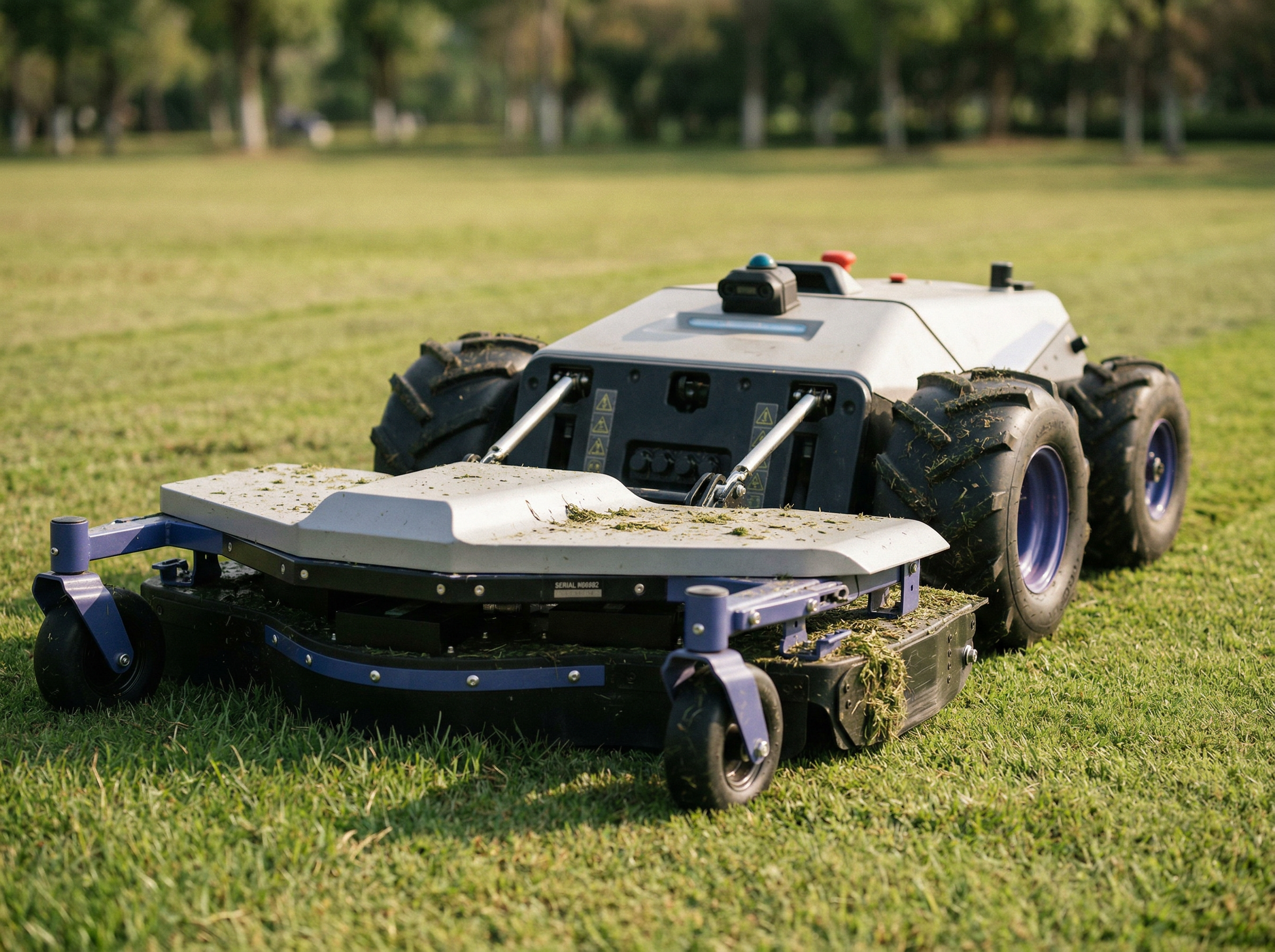
The cadence gap is the biggest single difference between the two service models. A standard fortnightly ride-on contractor visits 26 times a year. An autonomous mowing system on the AutoAcre Buy + Manage offer runs roughly 78 cycles per year — twice-weekly in summer (≈26 weeks × 2 = 52 mows), weekly in winter (≈26 weeks × 1 = 26 mows). About 3× the visits.
Each individual cycle is shorter and shallower than a fortnightly contractor pass — the system takes off less grass each time because there's less grass to take off. The result is a property that holds presentation continuously rather than alternating between freshly mowed and overgrown. On a Northern Rivers acreage block in summer, kikuyu and couch can grow several centimetres in a fortnight; the contractor cycle catches up and the property looks under-presented for half of every cycle. Twice-weekly autonomous keeps it level.
The cadence advantage isn't just aesthetic. Frequent shallow cuts produce healthier turf — less stress on the grass, finer clippings that mulch back into the soil instead of forming windrows, lower fungal pressure in damp Northern Rivers conditions. Ride-on contractors with full decks running fortnightly can compact wet ground and leave windrows that need raking. Autonomous cadence sidesteps both.
Year 1 favours the contractor; Year 8 doesn't
The financial comparison only makes sense over a long enough window. An autonomous mowing system is a capital purchase plus a recurring service fee; a contractor is pure recurring spend. The capital up-front means the contractor is cheaper in Year 1, and the autonomous system is cheaper in every year after that.
The crossover usually lands somewhere in the middle years, and the gap keeps widening after that. Where exactly depends on two things: what you pay your contractor now, and how much of your block is actually mowable. We work both out at the site assessment.
There's also residual value in the hardware at Year 8 (we estimate around 20%) and 3× the mowing frequency throughout. The bigger the mowable area, the wider the gap gets.
Book a site assessment and we'll run the numbers on your acreage and your current contractor rate.
Where ride-ons stop and autonomous keeps going
Slope handling is where the practical comparison gets uncomfortable for the contractor model. A ride-on mower is rated for safe operation up to around 15° slope — beyond that the operator is at risk of rollover. Most professional contractors will refuse to operate on slopes beyond 15° at all, which means a meaningful share of Northern Rivers hinterland blocks have sections their contractor simply doesn't mow.
The commercial-grade autonomous mower is rated to 30° slope. There's no operator on the unit, so the rollover risk doesn't apply the same way. The mower handles slopes the contractor refuses, every cycle, without anyone needing to be present. For Federal hill blocks, Possum Shoot acreage, Bangalow hinterland — the slope sections that have always been the unmowed problem suddenly aren't a problem.
The other safety consideration is the broader risk of human operators on the property. WHS-style risk assessment matters more on commercial sites than residential acreage, but for any owner thinking about it: a ride-on operator is a person on a machine with rotating blades. An autonomous unit is a machine with rotating blades, no person, low forward speed, and LiDAR obstacle avoidance. The risk profile is genuinely different.
The honest case for each model
A ride-on contractor still suits…
- Properties under 2.5 acres where capital cost doesn't justify the system
- Owners who actively want a person on site every fortnight (relationship, oversight)
- Edge trimming, hardscaping work, occasional manual jobs autonomous can't do
- Short-window ownership where the 8-year payback won't materialise
An autonomous system suits…
- 2.5–10 acre acreage where contractor pricing has become annoying
- Slope sections the contractor refuses or operates riskily on
- Holiday rentals or absentee owners who care about constant presentation
- Long-term holds where the 8-year cost picture compounds meaningfully
Many AutoAcre customers keep a contractor on call for the edge cases the autonomous system doesn't cover — edge trimming, manual mowing during downtime, occasional slope sections beyond 30°. The two models aren't always mutually exclusive. The right pattern for most acreage owners is autonomous handling routine high-frequency mowing and a contractor visiting quarterly or as-needed for the human-judgment edge work.
What the property actually looks like under each model
The most overlooked difference between the two service models is the day-to-day quality of how the property looks. A fortnightly ride-on contractor cycle produces an alternating pattern: freshly mowed and tidy for 3–5 days after a visit, then progressively rougher through the second week, then visibly under-presented for the last 3–4 days before the next visit. On a Northern Rivers acreage block with summer growth, the property spends roughly half of every fortnight looking less than its best.
Twice-weekly autonomous cadence eliminates that pattern. The property holds at a consistent presentation standard continuously. Visitors arriving on day 1 of the cycle see the same property as visitors arriving on day 13 — there isn't a "day 13" any more, just consecutive low-effort cycles. For holiday-rental owners this matters financially (guest reviews routinely mention grass length); for residential acreage owners it matters because the property looks the way you imagined when you bought it.
Cut quality at higher cadence is also genuinely better, not just more frequent. Each cut takes off only what's grown since the last cycle — fine clippings that mulch back into the soil rather than the windrows a fortnightly contractor produces. Less stress on the grass, less fungal pressure in damp Northern Rivers conditions, and no need for raking or clipping management as a separate task. Owners who switch from fortnightly to autonomous routinely report that the lawn itself looks healthier within a season — denser turf, fewer bare patches, less weed pressure — because the high-frequency low-stress cutting pattern is what kikuyu and couch genuinely prefer.
What a typical week actually looks like
With a fortnightly ride-on contractor
Tuesday week 1: contractor arrives 7:30am with ride-on on a trailer. Two hours of mowing across the 5 acres. Property looks great Tuesday afternoon and Wednesday. Thursday onwards through week 2: progressively less great. Day 12, 13, 14: the paddock is shin-deep in patches and looks neglected. Day 14 evening: anxiety about whether the contractor will actually arrive Tuesday morning as planned. Tuesday week 3: cycle repeats.
Plus: occasional rain delays push the schedule by a week, leaving 21+ days between cuts. Plus: the slope sections the contractor refuses sit longer between visits. Plus: edge work along hardscaping is a separate conversation. Plus: an invoice every month at $250/acre.
With an autonomous mowing system
The mower runs Tuesday and Friday in summer, Tuesday only in winter. Each cycle takes 4–6 hours and finishes during the day. The property looks the same on day 1 as it does on day 7. There's no "before the contractor comes" anxiety because there's no contractor; the system runs whether you're on site or not, and AutoAcre handles all the operational complexity (firmware, blade replacements, scheduling around weather) remotely.
Slope sections the contractor refused get included automatically — the autonomous unit's 30° rating handles them every cycle. Boundaries hold to 2 cm forever. Wet ground is read remotely and the system skips the cycle without anyone needing to make the call. One predictable monthly fee covers everything except ad-hoc call-outs.